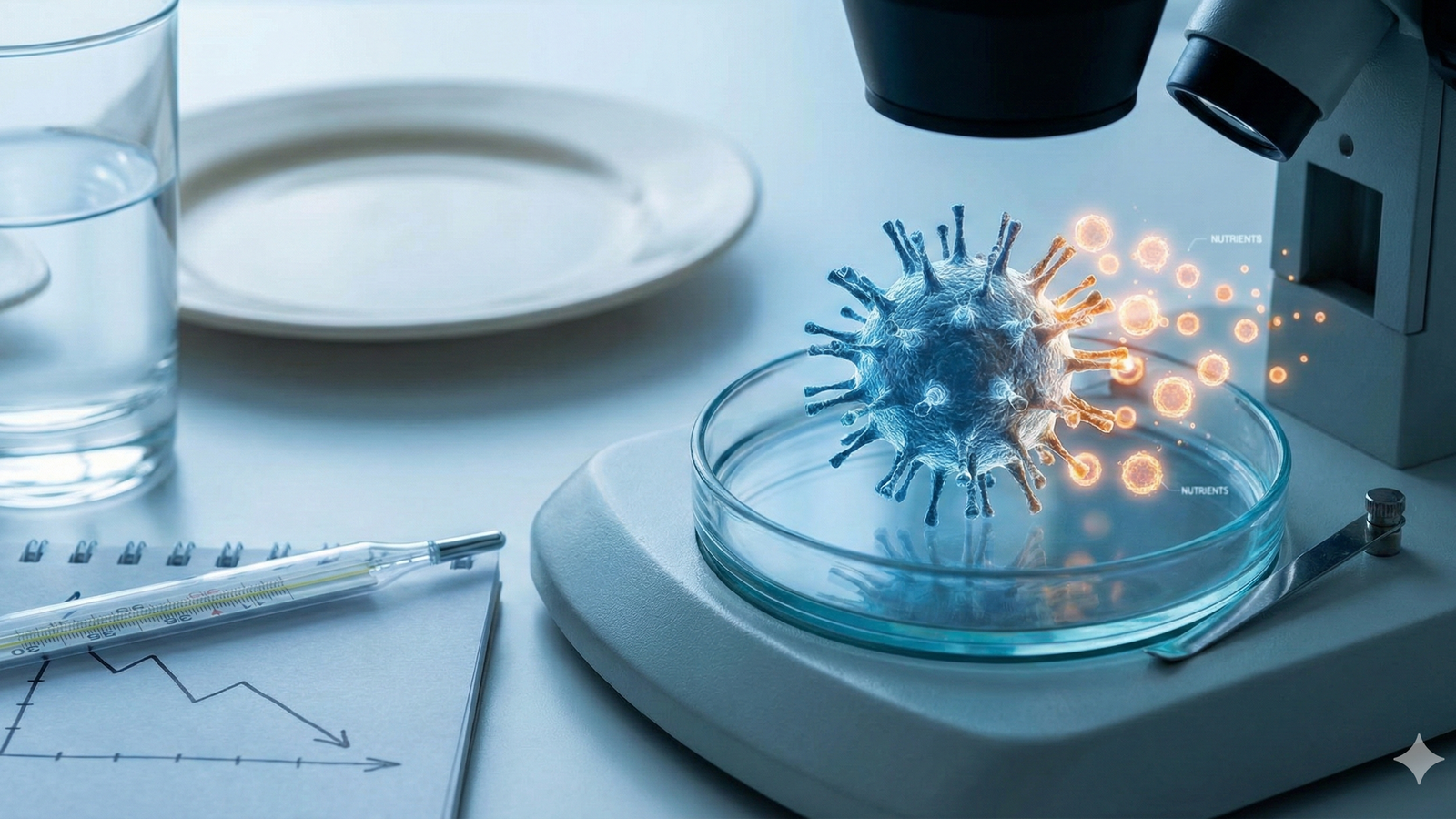
The immunometabolic paradigm shift.
The physiological response to acute viral infection represents one of the most profound bioenergetic events in human biology. Far from a localized skirmish between a pathogen and immune sentinels, a viral invasion triggers a systemic metabolic upheaval that reorients the host's entire energetic priority system.
This article evaluates a clinical protocol for early intervention of common colds and influenza. The protocol advocates for a counter-intuitive strategy: the immediate cessation of solid food intake (short-term fasting) coupled with aggressive parenteral micronutrient support (IV Vitamin C, Vitamin D, Zinc, Magnesium). This challenges the colloquial wisdom of "feed a cold," positioning itself instead on the cutting edge of immunometabolism.
The prodromal phase of viral infection — the first 24 to 48 hours — is a critical window where metabolic manipulation can decisively tip the balance in favor of the host.
By inducing a catabolic state via fasting, the host suppresses anabolic signaling pathways (specifically mTOR) that viruses hijack for replication, while simultaneously upregulating autophagy (xenophagy) to clear intracellular pathogens.
The bioenergetics of immunity: the "selfish" immune system.
When a pathogen breaches the mucosal barrier, the body initiates the Acute Phase Response. This response is metabolically expensive — in humans, the induction of a fever raises Basal Metabolic Rate by approximately 10–13% per 1°C increase in core body temperature. During a fulminant infection, glucose utilization by the immune system can account for over 60% of the body's total glucose turnover.
To secure the fuel necessary, the immune system engages a resource-reallocation program described as the "selfish immune system." The same cytokines that drive inflammation (TNF-α, IL-6) act on skeletal muscle and adipose tissue to induce acute peripheral insulin resistance — blocking glucose uptake by storage tissues and shunting it toward activated immune cells, which express insulin-independent GLUT1 and GLUT3 transporters.
By forcing food intake, one may inadvertently disrupt this reallocation. Ingesting carbohydrates stimulates insulin release, which drives glucose into storage tissues — directly antagonizing the immune system's metabolic strategy.
Sickness-associated anorexia: not a symptom, an adaptation.
Sickness-associated anorexia — the profound loss of appetite during infection — is observed in virtually every class of animals, from mammals to invertebrates. This universality suggests it is an ancient, conserved, and adaptive trait. The immune system actively suppresses the drive to eat, mediated by IL-1β and TNF-α acting on the hypothalamus.
Adaptive advantages include: behavioral conservation (avoiding predation), nutritional immunity (sequestering iron from pathogens), and reducing substrate availability for viral assembly.
Hyperglycemia and innate immune paralysis.
The classic 1973 Sanchez study demonstrated that ingestion of 100g of simple carbohydrates significantly depressed the phagocytic index of neutrophils — by approximately 50%, beginning within 30 minutes and persisting for at least 5 hours.
Why hyperglycemia paralyzes neutrophils:
- Competitive inhibition of Vitamin C. Neutrophils accumulate vitamin C against a concentration gradient, achieving intracellular levels 50–100× higher than plasma. The oxidized form (DHA) enters the cell via GLUT1 and GLUT3 — the same transporters used for glucose. In a hyperglycemic state, glucose floods the bloodstream and competitively inhibits DHA transport, rendering the neutrophil "internally scorbutic" despite adequate plasma levels.
- Impaired chemotaxis and adhesion. Hyperglycemia makes neutrophils "sticky," failing to migrate effectively toward viral distress signals.
- Glycation of immunoglobulins. Glycated antibodies lose efficiency in opsonization, blinding the neutrophil to the pathogen.
The recommendation to avoid sugar and juice is scientifically validated. These foods cause glucose spikes that physically impair the innate immune system's ability to contain the virus in the crucial early hours.
Cellular rewiring: the mTOR vs autophagy axis.
The cell operates in a binary mode: it is either in a state of Growth (Anabolism) or Repair/Defense (Catabolism). These states are mutually exclusive, governed by the antagonism between mTOR and autophagy.
mTOR: the viral "printer."
mTORC1 is the master regulator of protein synthesis. Activated by insulin, amino acids, and high energy status. Viruses — including influenza and coronaviruses — have evolved to forcibly activate mTOR via the PI3K/Akt pathway. This ensures rapid production of viral capsids and replication enzymes.
If the host eats protein and carbs, they provide the exogenous signal (insulin + amino acids) that synergizes with the virus's internal signal to maximally activate mTOR. They turn on the "printer" the virus is trying to use.
Autophagy: the intracellular "shredder."
Autophagy — and its specialized form, xenophagy — is the primary mechanism by which cells detect, engulf, and destroy intracellular pathogens. Fasting is the most potent physiological activator of autophagy:
- As glucose drops, the AMP:ATP ratio rises → activates AMPK.
- AMPK phosphorylates and inhibits mTORC1.
- AMPK also phosphorylates ULK1, initiating the autophagy cascade.
By fasting for 24–48 hours, the host actively suppresses the viral "printer" (mTOR) and turns on the viral "shredder" (autophagy).
The clinical dovetail: parenteral micronutrients.
IV Vitamin C (10–25g)
Oral vitamin C absorption is saturable; doses above 200mg plateau plasma at ~80–100 µmol/L. IV bypasses this gut limit, achieving plasma concentrations in the millimolar range (10,000–20,000 µmol/L). At these supraphysiological concentrations, vitamin C acts as a pro-drug for the generation of extracellular hydrogen peroxide — which diffuses into virus-infected cells (which often lack robust catalase) and damages viral RNA and capsid proteins.
Safety: G6PD deficiency is an absolute contraindication.
Vitamin D "Stoss therapy" (e.g., 50,000 IU)
Vitamin D binds to receptors on macrophages and bronchial epithelial cells, triggering transcription of Cathelicidin (LL-37) and beta-defensins. LL-37 is a potent broad-spectrum antiviral — it physically disrupts viral envelopes and inhibits replication of influenza and RSV. A single high dose provides the rapid genomic signal needed to arm the mucosal barrier.
IV Zinc and Magnesium
Zinc is a direct inhibitor of viral RNA-dependent RNA polymerase (RdRp). Magnesium is the counter-ion for ATP (biologically active ATP is Mg-ATP), stabilizes mast cells, and mitigates vein irritation from high-dose vitamin C.
The protocol synthesis.
- Fasting drops insulin and activates AMPK.
- AMPK shuts down mTOR and activates autophagy.
- Low glucose prevents neutrophil paralysis and ensures vitamin C transport into immune cells.
- IV nutrients provide the pharmacological ammunition (H2O2, LL-37, RdRp inhibition) that the optimized immune system uses to destroy the pathogen.
This synergistic approach transforms the host from a "fertile incubator" (high sugar, high mTOR) into a "hostile environment" (low sugar, high autophagy, high antimicrobial peptides).
Limitations and contraindications.
This protocol requires medical supervision:
- Type 1 diabetics — fasting can induce ketoacidosis.
- Pregnant/breastfeeding women — caloric restriction generally contraindicated.
- Eating disorders — fasting may trigger relapse.
- G6PD deficiency — absolute contraindication for high-dose IV vitamin C.
- Renal impairment — risk of oxalate nephropathy and magnesium accumulation.
Conclusion.
By integrating the evolutionary logic of anorexia, the molecular biology of the mTOR/autophagy switch, and the pharmacology of parenteral nutrition, this protocol offers a mechanistic blueprint for enhancing host resistance in the critical early hours of viral infection. In the war against viruses, the terrain is just as important as the pathogen.

